
Implement
6
Communicate and Monitor
2
There are hardly any requirements to substitute, but rather to stop using one or another chemical and substitution is a consequence of such bans or restrictions. Hence, the need to substitute is driven by broader regulatory frameworks:
Elimination of a chemical (no replacement)
Example: A fragrant ingredient in a mixture is removed as it has no function other than providing a pleasant smell during product use.
Drop-in substitution (1 to 1) of a chemical
One chemical is replaced by another without additional changes. Example: Cadmium containing yellow pigment in a mixture is replaced by an organic yellow pigment which is not considered hazardous.
Changed product or process design
by implementing chemical alternative
Example: In polymer pellets the phthalate plasticizer DEHP is replaced by the plasticizer DINCH. The entire polymer needs to be reformulated (by re-adjusting the concentrations of most other components) to achieve the desired function.
by implementing non-chemical solution
Example: The product's main material is changed from plastic to glass, e.g., in packaging. This would involve the use of very different chemicals, potentially eliminating the need to use plasticisers.
by implementing new technology
Example: Wood can be impregnated using biocides or by applying heat and pressure to the wood for a certain time.
Problem identification
Start by identifying substances of concern that are currently in use. Compile or update existing chemical inventory to facilitate identification of hazardous substances and prioritize. Identify the key functions that your substance of concern performs in the product or process.
More on Inventory: What is a chemical inventory?
Prioritise substances for substitution by focusing on those that are the greatest cause for concern. These typically include highly hazardous substances, substances that are not essential for the product’s functioning, and those likely to face regulatory restrictions or increasing market pressure in the short term.
Defining the scope of substitution
Defining the scope of substitution involves the identification of criteria to evaluate alternatives.
These criteria may concern:
These criteria are a good basis for later decision making and help to maintain focus on the essential aspects of substitution.
Inform and consult your supply chain, both clients and suppliers, to identify potential concerns and options.
Searching for alternatives
Start by defining the quality and performance of the product and identify all possible options that could lead to the elimination of the chemical of concern. These options may also include technical options, e.g., if a processing aid should be phased out, or using different materials (e.g., discuss with the customer whether or not to change from one type of polymer to another).
Various sources and contacts can help you to find alternative chemicals:
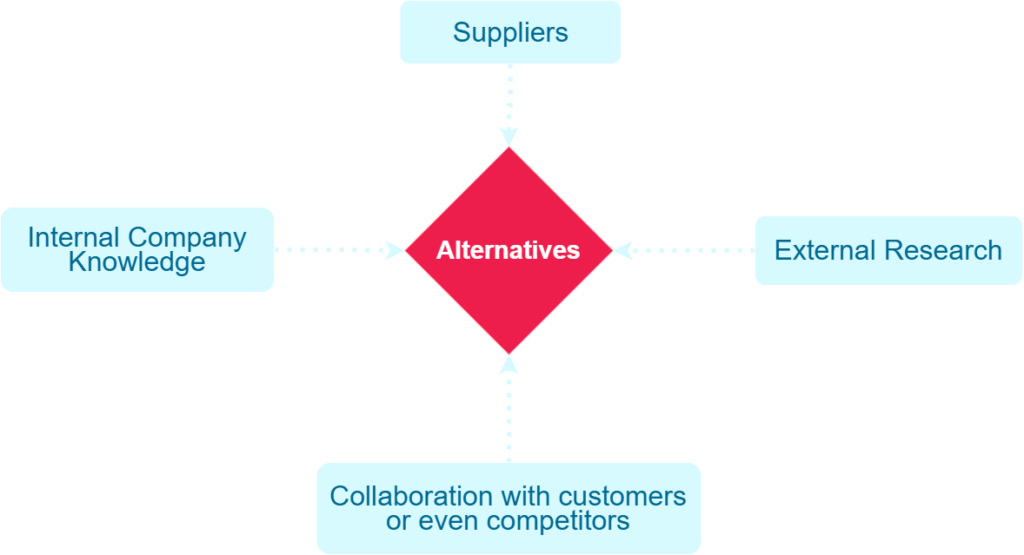
Preliminary assesment
All alternatives should be compliant with the regulatory requirements of your target markets and should not be banned or restricted in any legislation.
A practical approach is to first do a quick screening of all options – preliminary assessment, remove options that are clearly unsuitable, and then assess the remaining ones in more detail.
Preliminary assessment focuses on screening substances based on their hazardous properties. At this stage, alternatives associated with the most severe hazard classifications are identified so that they can be screened out early in the process.
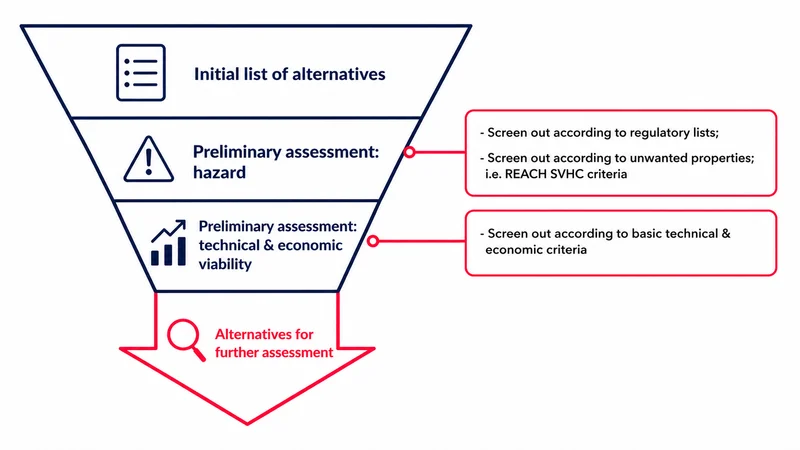
Preliminary assessment: screening out to ascertain whether substances are included in regulatory lists:
Alternatives should also be screened out, if they have any of the following hazardous properties but are not (yet) listed on a regulatory list:
PBT - persistent, bioaccumulative and toxic,
vPvB - very persistent, very bioaccumulative, PMT - persistent, mobile and toxic vPvM - very persistent, very mobile.
CMR - carcinogenic, mutagenic, reprotoxic, category 1, preferably also category 2,
EDC - endocrine disrupting chemicals categories
1 and 2.
Check the SIN list as it includes a lot of substances with the aforementioned properties. It is not a regulatory list but includes two types of substances:
Assessing, comparing and selecting alternative
Further assessment should cover:
In addition, communicate with your customer to ensure the reformulated product meets its requirements.
| Assessment area | Necessity of inclusion in the alternatives assessment |
| Hazard assessment | Always include it |
| Technical assessment | |
| Economic assessment | |
| Exposure assessment | Include if alternatives have similar hazardous properties in order to differentiate which of them is more likely to cause risks to humans or the environment |
| Environmental assessment | Include depending on the case, e.g. to support decision making on two similarly hazardous/risky alternatives or if the reduction of environmental impacts is very important to your company policy |
| Social assessment | Include if you find it relevant |
Highest priority for substitution
| Property | Hazard statement | |
| Code | Text | |
| CMR | H350 | May cause cancer |
| H340 | May cause genetic defects | |
| H360 | May damage fertility or an unborn child | |
| H361 | Suspected of damaging fertility or an unborn child | |
| Endocrine disruption* | EUH380 | May cause endocrine disruption in humans |
| EUH381 | Suspected of causing endocrine disruption in humans | |
| EUH430 | May cause endocrine disruption in the environment | |
| EUH431 | Suspected of causing endocrine disruption in the environment | |
| PBT and vPvB * | EUH440 | Accumulates in the environment and living organisms including in humans |
| EUH441 | Strongly accumulates in the environment and living organisms including in humans | |
| PMT and vPvM* | EUH450 | Can cause long-lasting and diffuse contamination of water resources |
| EUH451 | Can cause very long-lasting and diffuse contamination of water resources | |
Second priority for substitution
| Property | Hazard statement | |
| Code | Text | |
| CMR | H351 | Suspected of causing cancer |
| H341 | Suspected of causing genetic defects | |
| Reproductive toxicity | H362 | May cause harm to breast-fed children |
| Endocrine disruption | H343 May cause endocrine disruption in humans | |
| Specific target organ toxicity | H371 May cause damage to organs (or state all organs affected, if known) | |
| H372 | Causes damage to organs through prolonged or repeated exposure | |
| H373 | May cause damage to organs through prolonged or repeated exposure | |
Third priority for substitution
| Property | Hazard statement | |
| Code | Text | |
| CMR | H351 | Suspected of causing cancer |
| H341 | Suspected of causing genetic defects | |
| Sensitisation | H317 | May cause an allergic skin reaction |
| Acute toxicity | H310 | Fatal if coming into contact with skin |
| H330 | Fatal if inhaled | |
| Specific target organ toxicity | H331 | Toxic if inhaled |
| H373 | May cause damage to organs through prolonged or repeated exposure | |
| Long-term (chronic) aquatic toxicity | H410 | Very toxic to aquatic life with long-lasting effects |
| H411 Toxic to aquatic life with long-lasting effects | ||
Hazard assessment
1) Compare and benchmark hazards based on the EU classification as a first step.
The more severe the hazards are, the less suitable the alternative is from an (eco) toxicological point of view. In the event that no classification is available, you may find test results for at least some endpoints in the ECHA’s database or other scientific sources that you may use to compare hazards. You may want to compile a ranking list according to hazards. Ensure that you are aware of the availability of information and what you do not know (and that could turn out to be a bad surprise in the future).
2) After alternatives with unacceptable hazards have been screened out, a comparison of the hazards of the remaining alternatives should follow to rank the alternatives with the top one being the least hazardous.
As substituting one chemical may require changing of the entire mixture composition, including the use of further, new substances. To assess the overall change in hazard, all changes in components and major changes in their concentration should be considered in the hazard assessment.
As the exact composition will only be determined during technical testing of an alternative, you should work with an assumed composition at this stage.
The online tool ChemSelect supports the sustainability assessment of substances and mixtures, including a comparison of mixtures regarding their hazardousness. The GHS Column Model can assist you in the comparison of hazards: it provides a system or hierarchy of hazards clearly indicating what is “better or worse”.
At the end of this step, delete all originally identified alternatives that are classified with any of the most severe H statements (first list) as they would be regrettable substituted. Conduct the next steps with the now reduced list of possible alternatives.
It is not always possible to find non-hazardous or non-classified substitutes to replace hazardous substances. Certain hazards may be acceptable if the chemical replaces a more hazardous one; i.e., improvements may be better than not acting at all.
Exposure assessment
If all identified possible alternatives have very similar hazard profiles (H statements) you may want to assess their exposure potential to differentiate them further. This step is cumbersome and you may consider first textint the technial and economic feasiblity and only carry out this step if you need further decision help on what is the best alternative.
The assessment of exposures indicates the likelihood and extent to which humans, workers, consumers and the environment could be exposed to the chemical during its entire life cycle.
For the alternatives assessment, you may only consider mixture components that have changed by over 25% in concentration and start with a qualitative assessment:
If you want to quantify the exposure and risk of the alternatives, use available guidance on emission and exposure assessment. The scheme summarises a step-by-step process to identify if an exposure assessment is useful/needed to support a substitution decision and what level of detail is needed.
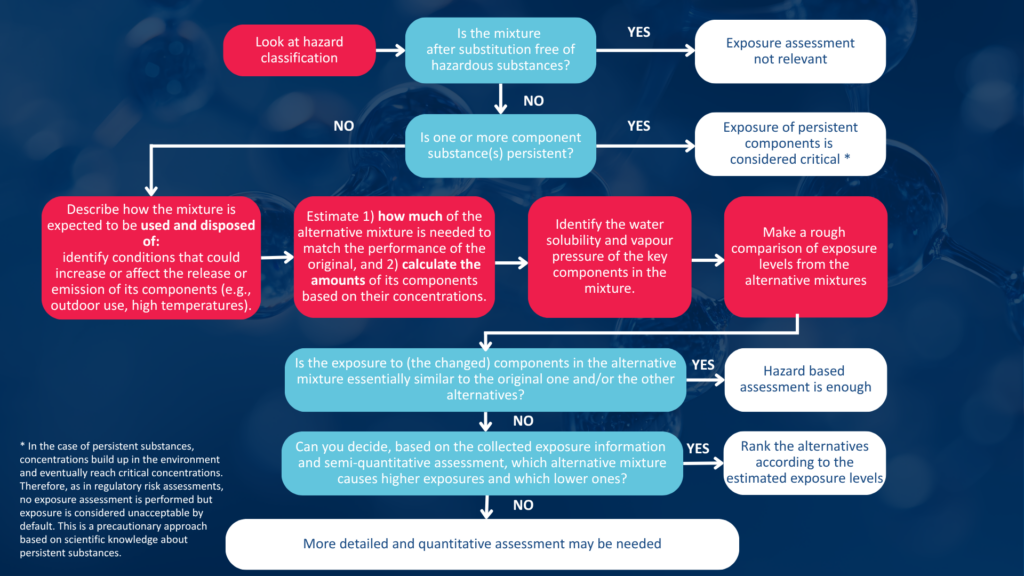
Technical assessment
The technical feasibility of an alternative is crucial as the functionality and performance of a mixture must be maintained or even improved.
As it is not possible to anticipate technical feasibility, test alternative mixtures first in the laboratory and later on at technical scale. At this stage, you will experiment to determine the exact composition for optimal performance.
The technical assessment should also include obtaining feedback from customers.
A detailed analysis should encompass performance, and operational feasibility. The analysis should answer the following questions:
Will switching to a new chemical/new mixture composition necessitate major changes to your own equipment and processes? If so, is a change in process or equipment feasible?
Will the product's quality continue to meet customer expectations; i.e. will the quality of the final product containing the mixture, or for the purposes of which it is used, remain the same or improve or deteriorate?
Will customers have to make any changes in the equipment and production processes in which the mixture is used and is this feasible? Have you discussed this with the customers concerned?
Economic assessment
The economic assessment may include analysis of:
Several factors need to be considered, many of which can only be estimated rather than calculated precisely.
The analysis should address the following questions:
Testing alternatives in real production
The last step of testing involves the use of the alternative at scale during normal production. Any challenges related to processing in the installation or product quality that could not be observed in lab-scale reformulation will emerge during full-scale production processes. Customers should be involved in this technical testing to ensure that the subsequent processing is not affected by the change in mixture composition.
Testing may require the specific attention of technical staff, as the manufacturing parameters have to be changed due to the (partly different) properties of the alternative(s). Be sure to keep good documentation and record keeping of your testing so that details on the tests are available at later stages in the process.
Apply the quality criteria defined in the first step to evaluate whether an alternative fulfils all the relevant requirements. You may want to conduct chemical analyses to ensure that the mixture does not contain any unwanted impurities or reaction products.
After completing the aforementioned steps, you should be able to make a sound and justified decision regarding which alternative to choose.
Implementation and checking of success
The last step in the substitution process is the use of the selected alternative in your full-scale manufacturing process. In all probability, you will be able to improve manufacturing efficiency over time as you work with the new material.
When introducing the new or changed product to your customers, be ready to take (critical) feedback and further improve or change the composition of the mixture.
Simple Alternatives Assessment Kit for Formulators
The simple alternative assessment kit highlights key points for formulators to consider and provides some guidance on situations in which an alternative can be considered to be “better” based on screening information. The kit outlines the assessment process, introduces several tools for assessment, and provides links to other frameworks and tools.
ChemSelect tool, available in several languages
ChemSelect is an online application that supports the sustainability assessment of substances and mixtures. Based on nine criteria, you can create a sustainability profile or compare different substances and mixtures with one another. It is designed for small and medium-sized enterprises that use chemicals in their processes and products. ChemSelect can be used with basic knowledge on chemicals (i.e. you should know safety data sheets and understand the main content).
Substitution and Alternatives Assessment Toolbox (SAAToolbox)
The OECD Substitution and Alternatives Assessment Toolbox (SAAToolbox) compiles resources relevant to chemical selection including substitution and assessment of alternatives, as well as the OECD SSIA (Safe(r) and Sustainable Innovation Approach) for nano-enabled and other emerging materials.
USEtox is a scientific consensus model endorsed by UNEP's Life Cycle Initiative for characterising human and ecotoxicological impacts of chemicals. The main output is a database of characterisation factors including fate, exposure, and effect parameters. It enables an in-depth assessment of environmental impacts, although expert knowledge is needed to operate and interpret the model effectively.
Online platform that helps companies find and compare safer alternatives to hazardous chemicals, connecting buyers with suppliers of verified chemical, material, and technology solutions.